Books
-
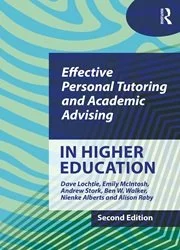
This is a comprehensive guide for higher education professionals engaged in student support, advising or personal tutoring roles. It covers a range of key topics relating to tutoring in the HE landscape including definitions, pedagogy, coaching, core values and skills, boundaries, monitoring students, undertaking group and individual tutorials and the need to measure impact.
A scholarly and practical text, it brings together relevant academic literature to inform personal tutoring practice and contextualise the role within HE policy. This second edition has been thoroughly updated, and explores topical and timely content with new chapters that examine the pedagogy of personal tutoring, key concepts surrounding effective student interactions, and inclusive personal tutoring. Further emphasis is placed on student engagement and motivation as well as how to effectively share responsibility and manage expectations. Reflective exercises are provided throughout the text to encourage critical thinking about this key role and support tutors’ own professional development.
Packed with actionable steps, this is a vital toolkit for higher education professionals at any stage of their career, and offers a wealth of expert guidance, resources and checklists to help develop meaningful and impactful connections with students throughout their learning journey.
-
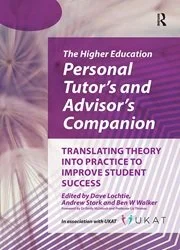
With contributions from 50 practitioners from across the sector, this text examines the key themes, theories and concepts relevant to personal tutors and academic advisors and translates these into real-world practice. Case study narratives from a range of settings demonstrate how student learning and outcomes can be improved, and related critical thinking activities encourage reflection on how these learnings can be applied in specific contexts. The book provides invaluable insights and support for all personal tutors and academic advisors, enabling practitioners to learn from each other, develop innovative ideas, and feel part of a community of learning.
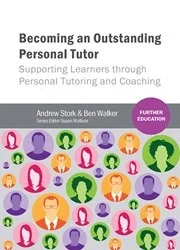
-
How confident do you feel in your personal tutoring role? In the face of ever-increasing and demanding learner issues, do you feel equipped to provide the essential support to meet their needs? This timely book provides you with essential help in an area which has often been given little attention in comparison with curriculum delivery by:
contextualising the support side of a teacher’s role within further education;
looking beyond conventional notions of personal tutoring and coaching;
appreciating the real world applications of issues;
recognising the benefits personal tutoring and coaching bring to learners and educational institutions;
reflecting on a variety of different approaches to support learners’ achievement as well as positively affecting institutional key performance indicators.
It provides proven practical advice and guidance for planning and delivering group tutorials, undertaking one to ones, identifying and managing vulnerable learners and those at risk of not achieving, as well as helping learners to progress onto their chosen career paths. It explores methods to engage the most disaffected and hard to reach learners, as well as stretching and challenging the more able.
It includes clear aims, detailed case studies, learning checklists and a unique self-assessment system for the reader and the educational institution. You are encouraged to develop your skills in order to influence individual learners as well as the systems, processes and performance of your educational institution by becoming an outstanding personal tutor.
The text is an excellent foundation for the majority of modules on teacher training qualifications and is relevant to any pre-service or in-service trainee teacher or existing practitioner with a personal tutoring role, a specialised personal tutor, manager or anyone in a learner-facing role within further education.
Peer-reviewed journal articles
-
The significance of personal tutoring continues to increase as a result of contextual developments and the outcomes of key research on student retention and success, and yet these developments simultaneously create significant challenges in delivery within the pastoral model of personal tutoring. In addition, it remains an under-developed and under-researched area. Personal tutors’ needs and concerns have been established, and assessment of an intervention to address them has been recommended. This study examines the impact of the intervention of tailored professional development materials for tutoring within a pastoral model created in response to these issues. It reveals the usefulness of this developmental support and the need for such guidance for this work. It is argued that there are implications in terms of approaches to tutoring within this pastoral model, developmental support provision and a need for consistency of standards in personal tutoring across the sector.
-
The Higher Education and Research Act established both a regulatory framework and the Teaching Excellence Framework (TEF) with associated metrics for student retention, progression and employability in the United Kingdom. As a key site in meeting these requirements, the significance of personal tutoring is clear. Despite this, according to existing institutional research, there is a need for developmental support, greater clarification on the requisite competencies, and adequate recognition for those undertaking this challenging role. Moreover, arguably compounding these concerns is the lack of distinct professional standards for personal tutoring and advising against which to measure effective practice, only recently addressed by the publication of The UKAT Professional Framework for Advising and Tutoring. Through a review of the literature supported by findings from a survey of practitioners, this paper discusses the need for such standards, and the skills and competencies populating them. Additionally, the usefulness of pre-existing standards pertinent to tutoring work (such as the United Kingdom Professional Standards Framework for Teaching and Supporting Learning in HE) are evaluated and the value and recognition with which personal tutoring standards could be associated are advanced. The survey supported the need for specific standards – represented by the UKAT framework – as evident from the literature. Justifications provided for both this and the opposing view are examined. Clarity for both individual practitioners and institutions was stipulated along with meaningful recognition and reward for this work which is considered highly important and yet ‘invisible.’ The participants and literature reviewed identify relevant content along with illuminating the debate about the relationships between personal tutoring, teaching and professional advising roles. Valuable analysis of standards, recognition and reward also emerged. This is considered by discussing the connection between standards and changes to practice, responses to policy developments and the purpose of ‘standards’ in comparison to ‘guidance.’ The paper proposes that the recent introduction and use of a bespoke framework is a necessary response to alleviate some of the current tensions which beset personal tutoring and advising in higher education.
-
Despite personal tutoring being a highly important area, it has a contested nature. One contention concerns its definition: in simple terms, what personal tutoring is and, by extension, what effective personal tutoring is. A book on personal tutoring (Stork and Walker, 2015) I co-authored entitled Becoming an Outstanding Personal Tutor - which aims to define the role of the personal tutor in further education as well as explain and demonstrate how to carry out the role effectively - raises a number of questions to be explored further. These have been brought into sharper focus by both my journey from further to higher education and as a result of my former ‘practical’ role as a manager of personal tutoring. The most urgent of these questions are centred on the theme of definition. What alternative definitions are out there? Are single definitions sufficient for the complexity of tutoring? When it comes to personal tutoring, what constitutes a definition anyway? The urgency stems from the increased importance placed on personal tutoring resulting from contextual developments and as shown from the findings of key research reports on the retention and success of students. Similarly, if there is a broad consensus that personal tutoring is vital, then further debate around what it stands for, and should stand for, in terms of good practice, needs to take place. Informed by critical pedagogy, this article will consider these questions of definition and the potential implications for organisations, those undertaking the role and students.
Book chapters
-
While being well-versed in your professional field and understanding the programme of study is crucial for supporting students, areas outside your expertise, such as pastoral issues and direction to the most suitable resources within the institution are equally important for meeting their needs. Andrew Stork, University Teacher in Medical Education at the University of Sheffield and Ben W Walker, Senior Lecturer in Educational Development at Oxford Brookes University, outline the academic advising/personal tutor role and some typical responsibilities.
-
This chapter explores, through rich interviews with international postgraduate students, their experiences of higher education transition as they enter and move through their studies. The authors use a social identity mapping activity developed for personal tutoring that visually surfaces the social nature of these transitional changes focusing upon how their identity is constructed and developed. Through using semi structured conversations, the activity aimed to surface aspects of their identity which are otherwise difficult to access. Strong evidence was found for the need to support international students in a variety of ways. These included support to manage expected and unexpected changes in who they are becoming, to manage changes in their stressors, and to develop reflective and reflexive awareness.